
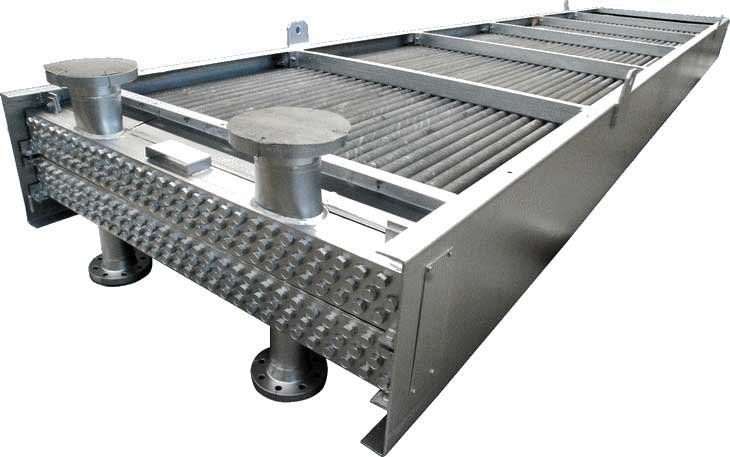
An air fin cooler, also known as an air-cooled heat exchanger, is a heat transfer device that uses air to cool a liquid or gas. It consists of a bundle of tubes with fins attached to them. The liquid or gas to be cooled flows through the tubes, while air is blown over the fins by a fan. The fins increase the heat exchanger's surface area, allowing for more efficient heat transfer.
Types of Air Fin Coolers-
There are several different types of air fin coolers, each with its advantages and disadvantages. The most common types of air fin coolers are:
Axial flow air fin coolers: These coolers have a fan that blows air axially through the tube bundle. Axial flow coolers are the most efficient type of air fin cooler, but they can be noisy.
Induced draft air fin coolers: These coolers have a fan that sucks air through the tube bundle from the bottom of the cooler. Induced draft coolers are quieter than axial flow coolers, but they are less efficient.
Forced draft air fin coolers: These coolers have a fan that blows air through the tube bundle from the top of the cooler. Forced draft coolers are less efficient than axial flow coolers, but they are more effective at cooling fluids and gases that are at a high temperature.
Dry cooling towers: These coolers use a combination of fans and natural convection to cool fluids and gases. Dry cooling towers are the most efficient type of air fin cooler, but they are also the most expensive.
Plate fin coolers: These coolers use plates instead of tubes to increase the surface area for heat transfer. Plate fin coolers are more compact than tube fin coolers, but they are also more expensive.
Extruded fin coolers: These coolers have fins that are extruded from the same material as the tube. Extruded fin coolers are more durable than other types of air fin coolers, but they are also more expensive.
Common Uses-
Air fin coolers are commonly used in a variety of applications, including:
Power plants: Air fin coolers are used to cool the condenser, which is responsible for converting steam back into water.
Refineries and petrochemical plants: Air fin coolers are used to cool a variety of fluids, such as petroleum products, chemicals, and gases.
Natural gas processing plants: Air fin coolers are used to cool natural gas before it is transported to pipelines.
Industrial machinery: Air fin coolers are used to cool a variety of industrial equipment, such as hydraulic oil coolers, engine radiators, and compressor intercoolers.
Air fin coolers are a relatively efficient and cost-effective way to cool fluids and gases. They are also relatively easy to maintain. However, air fin coolers are not suitable for applications where water is readily available or where the desired process outlet temperature cannot be achieved given the maximum ambient temperatures.
Advantages of using air fin coolers:
Efficient heat transfer: Air fin coolers have a large surface area, which allows for efficient heat transfer.
Low maintenance: Air fin coolers are relatively easy to maintain.
Cost-effective: Air fin coolers are a relatively cost-effective way to cool fluids and gases.


